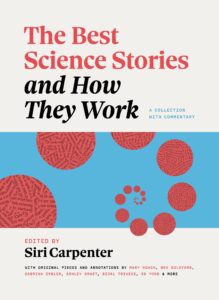
Today is publication day for a very unusual book that I contributed to. The Best Science Stories and How They Work is a compilation of eleven articles about science, selected by longtime science editor Siri Carpenter. Siri is also the co-founder of The Open Notebook, a project that provides resources and advice to science writers and would-be science writers.
What makes this collection unique is that Siri also asked eleven writers who did not write the original pieces to comment on them. What makes the story work? What decisions or choices did the writer make? How did they explain the science in a way that is understandable and that grabs the reader’s attention, without compromising accuracy? What were some unusual or surprising features of the article? The commenters based their annotations on interviews with the original authors as well as their own experiences as science writers.
Siri asked me to comment on an article written by Jordana Cepelewicz for Quanta Magazine, called He Dropped Out to Become a Poet. Now He’s Won a Fields Medal. The article is a profile of June Huh, one of the four mathematicians who won the Fields Medal, the most prestigious award in mathematics, in 2022. There are so many interesting things to talk about in Jordana’s article, starting with the title. Jordana captures the reader’s attention even before the body of the article begins: This is an article about a high-school dropout who has become an immense success. She’s telling an evergreen story of redemption, while at the same time confronting several stereotypes around mathematics… and dropouts.
This was a unique and fun assignment for me, because it gave me a chance to really think about the craft of writing and telling a story. Plus, it introduced me to a remarkable person, June Huh. A year later, I had the chance to interview June myself, and it was fascinating to see how the same person could appear differently to different writers. Jordana definitely revealed aspects of his personality and his story that I would never have suspected. It is a tribute to her skill as an interviewer. There is no question that her reporting has influenced the world’s perception of June Huh. After a lecture by June, I stood in the line of people waiting to ask questions of him. One common theme was, “What are the similarities between math and poetry?” even though June had not mentioned poetry at all in his lecture. Each time I heard that question, I thought, “Yes, there’s another person who read Jordana’s article.”
As I worked on my commentary, and later on my own article about June, I felt as if I had entered a hall of mirrors. At its center was June, reflected in Jordana’s interview and in my interview. Then there was Jordana’s story, reflected in my commentary. And me, reflecting on my story and her story and wondering what I could learn from them. Who is the story about, anyway? Is it about June or Jordana or me, or maybe the people reading the article and drawing their own conclusions?
I hope that this gives you at least a taste of the delights of this collection. I will certainly order this book at the first opportunity, because I want to read the other ten articles. I want to learn about some cool science, and I want to see how my fellow writers explained that science. Then, I want to see how their fellow writers tackled this odd hall-of-mirrors challenge of writing about somebody else’s article. The book will definitely benefit anyone who writes about science as a profession — a small group, I know — but I think it will also be fascinating for anyone who is interested in science or the intersection of media and science.